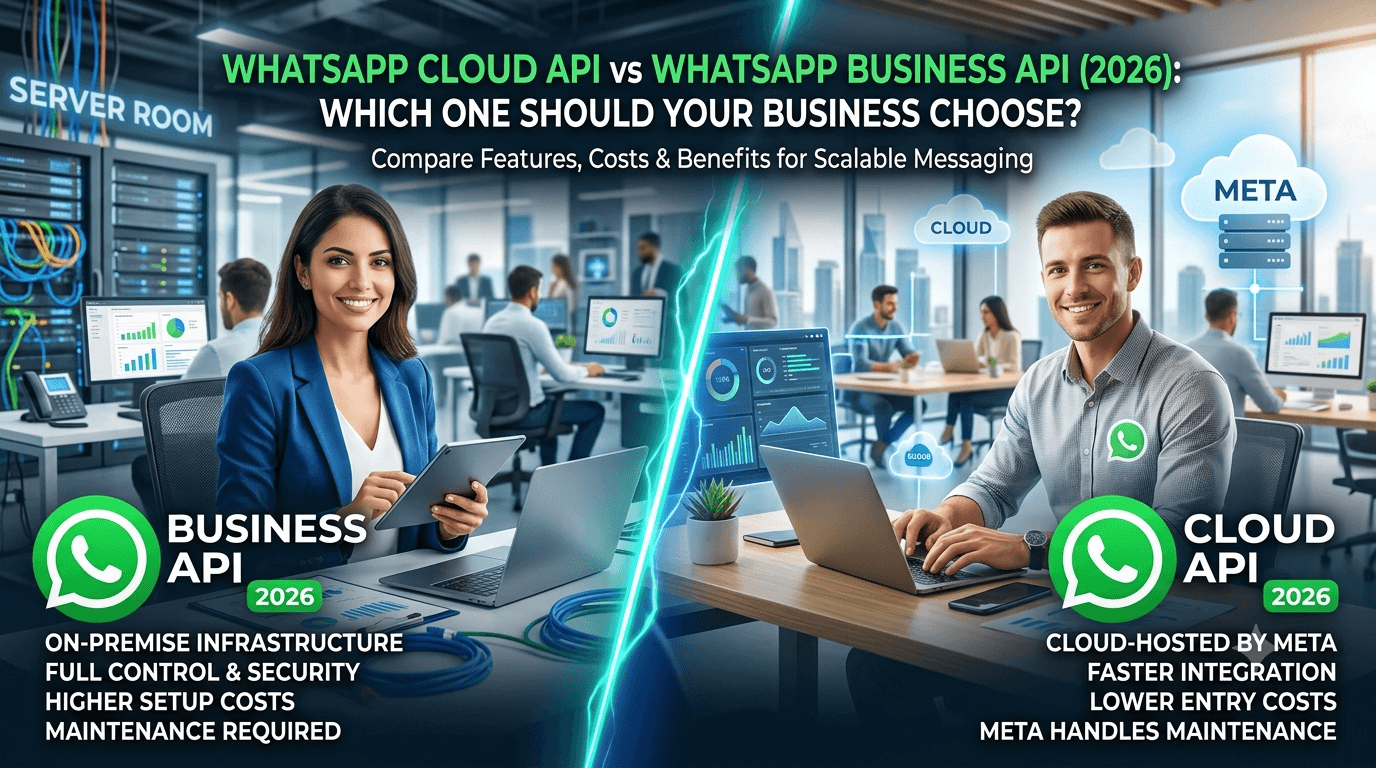
If you're planning to automate customer communication on WhatsApp, you've probably come across two terms: WhatsApp Cloud API and WhatsApp Business API.
Many businesses assume they're completely different products, while others think they're exactly the same. In reality, the Cloud API is Meta's cloud-hosted version of the WhatsApp Business Platform, while many businesses access it through a WhatsApp Business API provider that adds automation, integrations, and business-friendly tools.
Understanding the difference between WhatsApp Cloud API vs WhatsApp Business API will help you choose the right solution, control costs, and scale customer communication more effectively.
Whether you're building a SaaS product, running an eCommerce store, or looking to automate customer support, this guide explains everything in simple terms.
What Is WhatsApp Cloud API?
The WhatsApp Cloud API is Meta's cloud-hosted version of the WhatsApp Business Platform.
Instead of hosting the API on your own servers or managing infrastructure yourself, Meta handles the backend, making deployment much easier.
With the WhatsApp Cloud API, businesses can:
Send and receive customer messages
Automate conversations
Send order updates
Verify OTPs
Build chatbots
Connect with CRM systems
Manage customer support
Because Meta manages the infrastructure, businesses don't need to worry about server maintenance, software updates, or hosting.
What Is WhatsApp Business API?
The WhatsApp Business API is designed for businesses that need to communicate with customers at scale.
It supports features such as:
Shared team inboxes
CRM integrations
AI chatbots
Customer notifications
Broadcast messaging
Automated workflows
Analytics
Multi-agent customer support
Today, most businesses access the WhatsApp Business Platform through the Cloud API, but many choose a WhatsApp Business API provider because they also receive ready-made software, onboarding support, automation tools, and reporting dashboards.
WhatsApp Cloud API vs WhatsApp Business API: What's the Difference?
The biggest difference isn't the messaging capability—it's how you use it.
The WhatsApp Cloud API gives businesses direct access to Meta's infrastructure. Your development team is responsible for building dashboards, automation, and integrations.
A WhatsApp Business API provider, on the other hand, offers a complete platform built on top of the API. Instead of developing everything from scratch, businesses get ready-to-use software with automation, analytics, CRM integrations, and technical support.
If your company has experienced developers and wants maximum flexibility, the Cloud API is an excellent option.
If you want a faster setup with less technical work, working with a provider is often the better choice.
WhatsApp Cloud API vs WhatsApp Business API Features
Both solutions allow businesses to communicate with customers through WhatsApp, but they differ in the tools included.
The Cloud API focuses on providing the messaging infrastructure, while businesses build their own applications and workflows.
A WhatsApp Business API provider typically offers much more than messaging. Many platforms include a multi-channel live chat inbox or omnichannel messaging platform, allowing support teams to manage WhatsApp, email, and other communication channels from one dashboard.
Additional features often include:
AI powered chatbots for businesses
Shared team inbox
CRM integrations
Campaign analytics
Broadcast messaging
Customer support automation
No-code chatbot builders
Workflow automation
These features help businesses launch faster without investing months in custom development.
WhatsApp Cloud API Pricing vs WhatsApp Business API Pricing
One of the biggest differences businesses compare is pricing.
The WhatsApp Cloud API is hosted by Meta, but businesses are still responsible for building and maintaining their own applications. Depending on your implementation, you may also have messaging charges, development costs, and ongoing maintenance expenses.
When working with a WhatsApp Business API provider, pricing usually includes:
Monthly subscription
Shared inbox
CRM integrations
AI chatbot features
Customer support
Analytics
Automation tools
Although the subscription may appear more expensive initially, many businesses save time and development costs because everything is already built.
Is WhatsApp Cloud API Free?
Many businesses ask whether the Cloud API is free.
While Meta hosts the infrastructure, using the Cloud API doesn't necessarily mean there are no costs.
Depending on your messaging volume, software development, integrations, and business requirements, you may still incur messaging charges or operational expenses.
Instead of comparing only the API itself, evaluate the total cost of ownership, including development time, maintenance, and support.
Which Businesses Should Choose WhatsApp Cloud API?
The Cloud API is a good choice if your business:
Has an in-house development team
Wants complete control over integrations
Builds custom software
Needs flexible API access
Plans to develop its own WhatsApp Communication Platform
Wants to implement WhatsApp Automation for SaaS
It's particularly suitable for SaaS companies and technology businesses that want complete flexibility.
Which Businesses Should Choose a WhatsApp Business API Provider?
A WhatsApp Business API provider is often the better choice if your business wants to launch quickly without managing technical infrastructure.
It's ideal if you need:
Shared inboxes
AI chatbots
CRM integration
Customer analytics
Broadcast messaging
Technical support
Marketing automation
Customer support automation
Many providers also support WhatsApp API for E-commerce, making it easy to automate order confirmations, shipping notifications, abandoned cart reminders, and customer service.
Instead of building these workflows yourself, businesses can start using them almost immediately.
Which Option Is Better?
There isn't a single answer because every business has different requirements.
If your company has an experienced development team and wants complete flexibility, the WhatsApp Cloud API provides direct access to Meta's platform.
If your goal is faster deployment, built-in automation, CRM integrations, AI chatbots, and ongoing support, a WhatsApp Business API provider usually offers the better overall experience.
Many growing businesses start with a provider and later migrate to a custom Cloud API implementation as their technical capabilities expand.
Frequently Asked Questions
Is WhatsApp Cloud API the same as WhatsApp Business API?
The Cloud API is Meta's cloud-hosted implementation of the WhatsApp Business Platform. Many providers build additional software, automation, and business tools on top of it.
Which is better: WhatsApp Cloud API or WhatsApp Business API?
It depends on your business needs. Companies with in-house developers often prefer the Cloud API, while businesses looking for an all-in-one solution usually choose a WhatsApp Business API provider.
Is WhatsApp Cloud API free?
Not entirely. While Meta hosts the infrastructure, businesses may still have messaging costs, development expenses, or software subscription fees depending on how they use the platform.
Can I switch from a Business API provider to the Cloud API?
Yes. Many businesses begin with a provider for faster implementation and later migrate to a custom Cloud API solution as they grow.
Do both support AI chatbots?
Yes. Both support chatbot development, but most providers include ready-made chatbot builders and AI powered chatbots for businesses, reducing the need for custom development.
Final Thoughts
Choosing between the WhatsApp Cloud API vs WhatsApp Business API isn't about deciding which platform is better—it's about selecting the solution that best fits your business goals.
If you have a technical team and want full control over development, the Cloud API offers flexibility and customization. If you prefer a ready-to-use platform with automation, CRM integrations, analytics, and customer support, partnering with a WhatsApp Business API provider is often the faster and more practical choice.
Whether you're building a SaaS product, running an online store, or scaling customer support, investing in the right WhatsApp solution can improve response times, automate repetitive tasks, and create a better customer experience. Before making a decision, compare pricing, features, scalability, and long-term business needs to choose the platform that will grow with your business.